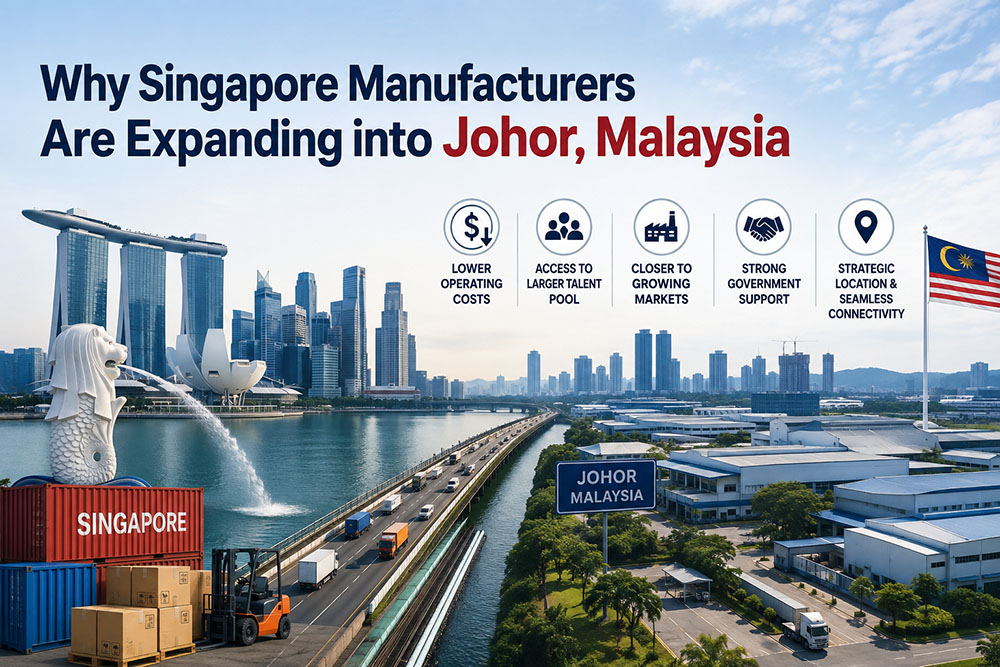
The Question Is No Longer “Singapore or Johor?”
When people talk about Singapore manufacturers moving to Johor, the conversation often becomes too simplistic. It is framed as a cost story: Singapore is expensive, Johor is cheaper, so manufacturers cross the border. That may be part of the calculation, but it is not the most useful way to understand what is happening.
A stronger model is emerging. Companies can keep the functions that benefit from Singapore’s business environment, technology ecosystem, finance, connectivity and regional talent while placing selected manufacturing, warehousing or expansion activities in Johor. The Johor-Singapore Special Economic Zone is designed around exactly this idea of complementary strengths.
Singapore EDB describes a twinned operating model in which companies use Singapore for headquarters, R&D, innovation and advanced activities while tapping Johor for land, labour and an expanding industrial base. For manufacturers that are running out of room, need a second production site or want to build resilience into the supply chain, Johor can therefore be an extension of the Singapore operation rather than a replacement for it.
1. Industrial Space Is Easier to Scale in Johor
Manufacturing growth is physical. A company can increase software capacity without taking another acre of land, but a production business eventually needs more floor space, loading areas, storage, utilities and sometimes a larger buffer from surrounding uses. Singapore’s limited land means every expansion decision carries a high opportunity cost.
Johor gives manufacturers more choices. A company can lease a ready factory, acquire an industrial building, buy industrial land or develop a purpose-built facility. It can also plan for future phases instead of solving only the next two years of space demand.
This is especially important for businesses with large equipment, warehousing, assembly operations, outdoor yards or processes that do not need to occupy premium urban land. The ability to secure an industrial site with room to grow can be strategically more important than the headline saving on rent.
2. The Border Is Close Enough for a Two-Site Operating Model
Johor’s geographic advantage is obvious on a map, but its operational importance deserves more attention. Senior management can remain in Singapore while production teams operate in Johor. Engineers can travel for commissioning, audits and troubleshooting. Customers can visit both locations within the same regional trip. Parts and finished goods can move across a familiar cross-border logistics corridor.
This proximity allows companies to split functions deliberately. A Singapore office can handle regional sales, treasury, R&D or customer management while a Johor plant handles fabrication, assembly, packaging, warehousing or other space-intensive activities. The structure can be more flexible than a full relocation to a distant lower-cost country.
The JS-SEZ agreement specifically aims to improve goods connectivity, movement of people and the wider business ecosystem between Johor and Singapore. Those improvements matter to manufacturers because the viability of a two-site model depends on how efficiently people, components and information move between the two operations.
3. Johor Can Add Capacity Without Forcing a Company to Abandon Singapore
For many owners, leaving Singapore entirely is not desirable. Customers may associate the business with Singapore. Banks, investors and headquarters teams may be based there. Certain engineering or R&D activities may still be best located inside the city-state. A Johor expansion lets a company preserve those advantages while solving capacity constraints elsewhere.
This is why the phrase ‘relocation to Johor’ can sometimes be misleading. The actual project may be an expansion, a second factory, a regional warehouse or a specialised production line. The Singapore entity continues to play an important role while Johor becomes the operating platform for the next stage of growth.
Singapore EDB has highlighted companies using twinned operations across the two markets to strengthen supply-chain resilience. In 2026, it cited logistics operators including DHL, UPS and Kuehne+Nagel as examples of businesses drawing on both Singapore and the JS-SEZ. Manufacturing companies can apply the same logic in their own way.
4. The JS-SEZ Gives the Expansion Story More Structure
Cross-border manufacturing existed long before the JS-SEZ, but the zone gives the relationship a clearer policy framework. The agreement between Malaysia and Singapore is intended to attract investment, improve movement across the border and strengthen the business ecosystem. It covers sectors including manufacturing, logistics, digital economy, energy, business services and green economy.
Different Johor flagship areas have different strengths. Iskandar Puteri combines manufacturing and business services with Singapore proximity. Tanjung Pelepas-Tanjung Bin supports manufacturing and logistics. Pasir Gudang has a heavier industrial and port-oriented profile. Senai-Skudai combines manufacturing, logistics, digital economy and education. Kulai-Sedenak is increasingly associated with technology and large-scale development.
This means a Singapore manufacturer does not need to treat ‘Johor’ as one market. The site should be selected based on the operation itself: customer geography, container movements, airport use, workforce, utilities, building specification and the type of suppliers the company needs nearby.
5. Supply-Chain Resilience Is a Better Reason Than Cost Alone
Cost savings are useful, but a factory expansion based only on cheaper rent is fragile. Wages change. Currency moves. Incentives expire. A stronger investment case is one that improves the company’s ability to serve customers and withstand disruption.
A Johor facility can provide additional production capacity close to Singapore, reduce dependence on a single site and create space for inventory or backup operations. If a company is serving Southeast Asian customers, Johor also places it inside Malaysia’s industrial network while remaining connected to Singapore’s global logistics and finance ecosystem.
The Singapore Business Federation found strong interest in the JS-SEZ among Singapore businesses even before the zone was finalised. In its engagement with 160 companies, 93% expressed interest in opportunities related to the proposed zone. That level of interest suggests companies are looking beyond simple rental comparisons and considering how a cross-border operating model can support future growth.
Which Singapore Manufacturers Are Most Likely to Benefit?
Johor will not suit every Singapore company. Businesses whose operations are highly dependent on being physically next to Singapore customers may have less reason to move production. Others may find that part of the operation can be separated without affecting service quality.
Electronics and electrical manufacturers
Businesses that need additional production or assembly space while maintaining engineering, sales or management functions in Singapore.
Precision engineering and metal fabrication
Companies with machinery-intensive operations, fabrication lines, tooling or subcontract manufacturing that need larger industrial premises.
Food and consumer product manufacturers
Businesses requiring production, packaging, cold-chain or distribution space, subject to relevant regulatory and facility requirements.
Logistics and distribution companies
Operators that want warehouses or regional distribution capacity linked to Singapore’s ports, airport and customer base.
Medical device and technology suppliers
Companies that can separate regulated manufacturing or assembly functions from Singapore-based R&D, management or commercial activities.
Industrial equipment and engineering companies
Businesses supporting construction, data centres, semiconductor plants and other industrial projects across Johor and Singapore.
Choosing the Right Johor Location
Iskandar Puteri / SiLC
This western corridor can be attractive to companies that value proximity to Singapore’s Tuas side, Port of Tanjung Pelepas and established industrial developments. It can suit manufacturing, logistics and regional distribution activities.
Senai
Senai combines manufacturing, highway connectivity and airport access. It can suit electronics, engineering, logistics and businesses whose staff or customers travel frequently by air.
Kulai
Kulai offers larger growth corridors and is increasingly associated with advanced technology and data centre investment. It can be relevant to manufacturers that need scale and are planning a long-term facility rather than a small urban unit.
Pasir Gudang
Pasir Gudang has a mature heavy-industrial and port-related ecosystem. Manufacturers dealing with bulk materials, chemicals, engineering, commodities or port logistics may find its industrial profile more suitable than western Johor.
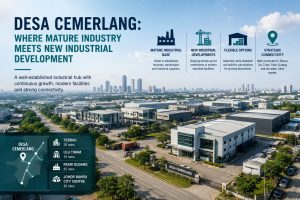
Skudai / Ulu Tiram / Desa Cemerlang
These mature industrial areas can suit SMEs, engineering companies, light manufacturers, distributors and businesses that want access to the wider Johor Bahru workforce and customer market.
What Singapore Companies Should Calculate Before Expanding
A cross-border expansion should be modelled as an operating decision, not a property decision. The factory is only one line in the cost structure. Companies should compare the full effect on production, people and logistics.
- Total occupancy cost, including renovation, utilities, maintenance and property-related charges.
- Cross-border transport frequency for materials, finished goods and employees.
- Customs, import/export and product-origin implications for the proposed operating model.
- Availability and cost of technical labour for the actual manufacturing process.
- Power, water, gas, wastewater and other utility requirements.
- Customer response time and whether the Johor location changes service levels.
- Management travel requirements between Singapore and Malaysia.
- Tax, transfer-pricing, corporate structure and regulatory implications.
- Whether the facility has room for expansion if the Johor operation succeeds.
- Business continuity benefits from operating more than one physical site.
Foreign Company Setup and Professional Support
A Singapore company establishing operations in Malaysia will normally need more than a factory lease. Corporate structure, Malaysian company requirements, tax, accounting, payroll, legal documentation, licences and industry-specific approvals all need to be considered.
K Industrial Solutions’ affiliate model is useful here because the property search can sit inside a wider establishment process. Industrial property advisors can focus on the site, while legal and corporate professionals handle the transaction, company setup and ongoing compliance. That reduces the risk of a company choosing a building first and discovering later that the operating structure or approvals do not fit the plan.
Foreign investors should obtain professional advice specific to their transaction rather than relying on general online guidance, especially where incentives, ownership, tax or regulated activities are involved.
Why Now Is a Good Time to Evaluate Johor
Johor entered a new phase after the JS-SEZ agreement was exchanged in January 2025. Investment interest has increased, infrastructure projects are progressing and both governments are actively promoting a more integrated cross-border economy. Malaysia’s 2025 investment data also showed Singapore as the largest source of approved foreign investment, while Johor recorded the highest approved investment value among Malaysian states.
Those numbers do not guarantee that every Singapore manufacturer should open a Johor plant. They do show that the direction of investment is real. Companies that already face capacity, cost or resilience pressures have a reason to evaluate the market before their property requirement becomes urgent.
The best projects will not be the ones that move the most activity out of Singapore. They will be the ones that design the right division of work between Singapore and Johor, using each location for what it does best.
How K Industrial Solutions Can Support Singapore Manufacturers
K Industrial Solutions assists Singapore businesses, manufacturers and investors looking for factories, warehouses and industrial land in Johor. Instead of starting with a long property list, the team can first understand the operational requirement: industry, floor area, power, logistics, workforce, border preference, lease or purchase structure and future expansion plan.
Suitable sites can then be shortlisted across Iskandar Puteri, SiLC, Senai, Kulai, Pasir Gudang, Skudai and other industrial areas. K Industrial Solutions can also coordinate professional introductions for legal transactions, company incorporation, accounting, taxation and compliance support through its affiliate network.
For Singapore companies, Johor should not be viewed simply as a cheaper address. Used well, it can become the second half of a stronger regional operating platform.
Looking for industrial land, factories for sale or factory rental opportunities in Johor? Speak with K Industrial Solutions to explore strategic industrial property options for your business expansion in Malaysia.
Frequently Asked Questions
Why are Singapore manufacturers expanding into Johor?
The main reasons include access to larger industrial sites, room for future expansion, proximity to Singapore and the ability to combine Singapore-based strategic functions with Johor-based manufacturing or warehousing.
Does a Singapore company need to move everything to Johor?
No. Many companies may benefit more from a two-site model where headquarters, R&D or commercial functions remain in Singapore while selected production and logistics activities operate in Johor.
Which Johor areas are closest to Singapore manufacturers?
Iskandar Puteri and the western Johor corridor are especially relevant to businesses using the Second Link and Port of Tanjung Pelepas. Other areas such as Senai, Kulai and Pasir Gudang may be better depending on the industry.
Is Johor only attractive because factory space costs less?
No. Lower occupancy cost can help, but the stronger reasons include scale, supply-chain resilience, industrial land availability, workforce access and integration with Singapore through the JS-SEZ.
What is the JS-SEZ?
The Johor-Singapore Special Economic Zone is a bilateral initiative designed to improve investment, movement of goods and people, and the business ecosystem across designated areas in Johor and Singapore.
Can a Singapore company buy a factory in Johor?
Foreign ownership may be possible subject to Malaysian law, Johor state requirements, property conditions and transaction-specific rules. Legal advice should be obtained before purchase.
Should a Singapore manufacturer rent first or buy immediately?
Renting can be useful for testing a Johor operation or entering quickly. Buying may suit companies with a long-term commitment, specialised equipment and a need for greater control over the property.
Can K Industrial Solutions help with company setup as well as property?
K Industrial Solutions focuses on industrial property and site selection but can connect clients with affiliate professionals for legal, accounting, tax and company secretarial support.